Stan książek
Nasze książki są dokładnie sprawdzone i jasno określamy stan każdej z nich.


Nowa
Książka nowa.
Używany - jak nowa
Niezauważalne lub prawie niezauważalne ślady używania. Książkę ciężko odróżnić od nowej pozycji.
Używany - dobry
Normalne ślady używania wynikające z kartkowania podczas czytania, brak większych uszkodzeń lub zagięć.
Używany - widoczne ślady użytkowania
zagięte rogi, przyniszczona okładka, książka posiada wszystkie strony.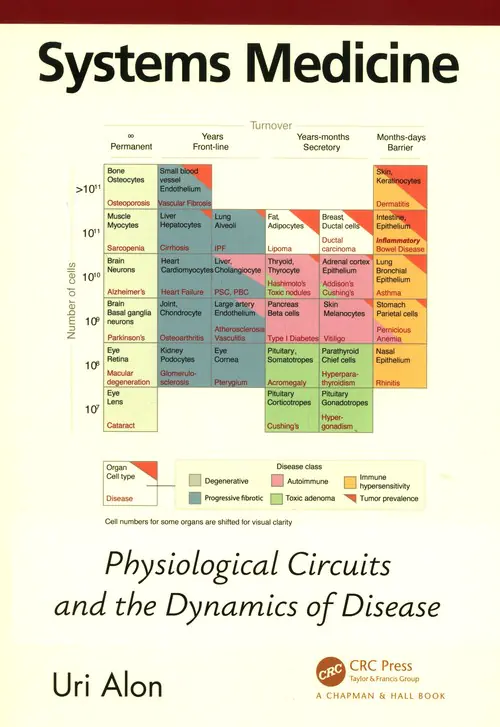
Systems Medicine
Masz tę lub inne książki?
Sprzedaj je u nas

Why are some diseases prevalent while others remain absent? In his insightful work, Alon, a pioneer in the field of systems biology, lays the groundwork for systems medicine. The book begins with fundamental principles and explores the reasons behind the construction of physiological circuits. These circuits possess vulnerabilities that elucidate the emergence of certain diseases and suggest innovative treatment pathways. By the conclusion, readers are empowered to utilize straightforward yet robust mathematical models to characterize these circuits. The book delves into three primary areas: hormone circuits, immune circuits, and the processes of aging and age-related diseases, culminating in a conceptual periodic table of diseases. Alon writes in a manner that is comprehensible to a wide readership, including undergraduates, postgraduates, and research professionals from computational or biological disciplines. The mathematical aspects are approachable, with the option to skip them if desired. For those seeking a deeper understanding, the text provides a series of classroom-tested exercises.
Wybierz stan zużycia:
WIĘCEJ O SKALI
Why are some diseases prevalent while others remain absent? In his insightful work, Alon, a pioneer in the field of systems biology, lays the groundwork for systems medicine. The book begins with fundamental principles and explores the reasons behind the construction of physiological circuits. These circuits possess vulnerabilities that elucidate the emergence of certain diseases and suggest innovative treatment pathways. By the conclusion, readers are empowered to utilize straightforward yet robust mathematical models to characterize these circuits. The book delves into three primary areas: hormone circuits, immune circuits, and the processes of aging and age-related diseases, culminating in a conceptual periodic table of diseases. Alon writes in a manner that is comprehensible to a wide readership, including undergraduates, postgraduates, and research professionals from computational or biological disciplines. The mathematical aspects are approachable, with the option to skip them if desired. For those seeking a deeper understanding, the text provides a series of classroom-tested exercises.
Szczegóły
Inne książki: Alon Uri

Podobne produkty
Może Ci się spodobać
Inne książki z tej samej kategorii

Napisz opinię o książce i wygraj nagrodę!
W każdym miesiącu wybieramy najlepsze opinie i nagradzamy recenzentów.
Dowiedz się więcejWartość nagród w tym miesiącu
880 zł
Dodaj swoją opinię
Zaloguj się na swoje konto, aby mieć możliwość dodawania opinii.
Czy chcesz zostawić tylko ocenę?
Dodanie samej oceny o książce nie jest brane pod uwagę podczas losowania nagród. By mieć szansę na otrzymanie nagrody musisz napisać opinię o książce.
Już oceniłeś/zrecenzowałeś te książkę w przeszłości.
Możliwe jest dodanie tylko jednej recenzji do każdej z książek.
Sposoby dostawy
Odbiór w punkcie (6)
InPost Paczkomat 24/7

14,99 zł
DPD Pickup Automaty i Punkty Odbioru

10,49 zł




Dostawa na adres (7)
GLS U Ciebie - Kurier

14,99 zł
Kurier DPD

14,99 zł





Sposoby płatności
Płatność z góry
Przedpłata

Zwykły przelew
