Stan książek
Nasze książki są dokładnie sprawdzone i jasno określamy stan każdej z nich.


Nowa
Książka nowa.
Używany - jak nowa
Niezauważalne lub prawie niezauważalne ślady używania. Książkę ciężko odróżnić od nowej pozycji.
Używany - dobry
Normalne ślady używania wynikające z kartkowania podczas czytania, brak większych uszkodzeń lub zagięć.
Używany - widoczne ślady użytkowania
zagięte rogi, przyniszczona okładka, książka posiada wszystkie strony.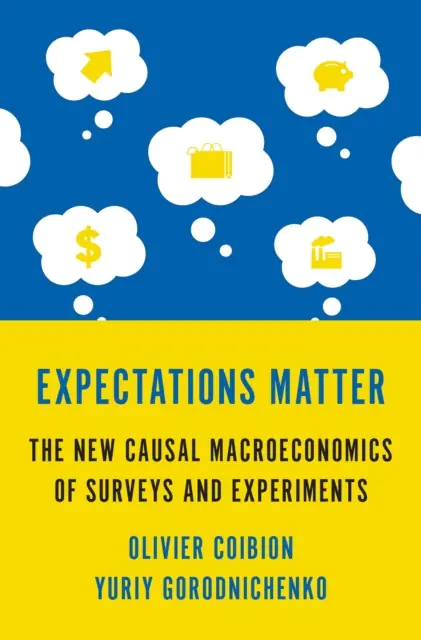
Expectations Matter. The New Causal Macroeconomics of Surveys and Experiments
Masz tę lub inne książki?
Sprzedaj je u nas

What impact do beliefs about the economy have, and why is it important to understand them? The expectation of future events plays a crucial role in economic actions—affecting everything from household spending habits to the price-setting behavior of companies and the policy decisions of central banks. Despite its importance, understanding precisely how expectations shape decisions has long been challenging for researchers. Olivier Coibion and Yuriy Gorodnichenko tackle this issue in their book by introducing a novel empirical method: the use of randomized controlled trials (RCTs) to explore the causal effects of expectations. Their research, spanning over a decade, demonstrates how targeted information treatments can create variations in beliefs, allowing for the measurement of how these beliefs impact actual decision-making. The authors reevaluate the limitations associated with traditional rational expectations models, providing a deeper, evidence-based insight into how economic perceptions form and influence actions. By combining the reliability of field experiments with the overarching questions of macroeconomics, they offer a clear and practical guide to this innovative methodology—covering everything from survey design to the implementation process and assessing how beliefs translate into behavior.Though much of their work concentrates on the expectations of inflation, the later sections delve into how their approach provides insights into the impact of uncertainty on decision-making for firms and households, the role of expectations in financial behavior, and the influence of social effects on consumer spending. This book equips economists and social scientists with a new framework for understanding the mechanisms of belief formation and its significance in economic contexts.
Wybierz stan zużycia:
WIĘCEJ O SKALI
What impact do beliefs about the economy have, and why is it important to understand them? The expectation of future events plays a crucial role in economic actions—affecting everything from household spending habits to the price-setting behavior of companies and the policy decisions of central banks. Despite its importance, understanding precisely how expectations shape decisions has long been challenging for researchers. Olivier Coibion and Yuriy Gorodnichenko tackle this issue in their book by introducing a novel empirical method: the use of randomized controlled trials (RCTs) to explore the causal effects of expectations. Their research, spanning over a decade, demonstrates how targeted information treatments can create variations in beliefs, allowing for the measurement of how these beliefs impact actual decision-making. The authors reevaluate the limitations associated with traditional rational expectations models, providing a deeper, evidence-based insight into how economic perceptions form and influence actions. By combining the reliability of field experiments with the overarching questions of macroeconomics, they offer a clear and practical guide to this innovative methodology—covering everything from survey design to the implementation process and assessing how beliefs translate into behavior.Though much of their work concentrates on the expectations of inflation, the later sections delve into how their approach provides insights into the impact of uncertainty on decision-making for firms and households, the role of expectations in financial behavior, and the influence of social effects on consumer spending. This book equips economists and social scientists with a new framework for understanding the mechanisms of belief formation and its significance in economic contexts.
Szczegóły
Inne książki: Olivier Coibion

Podobne produkty
Może Ci się spodobać
Inne książki z tej samej kategorii

Napisz opinię o książce i wygraj nagrodę!
W każdym miesiącu wybieramy najlepsze opinie i nagradzamy recenzentów.
Dowiedz się więcejWartość nagród w tym miesiącu
880 zł
Dodaj swoją opinię
Zaloguj się na swoje konto, aby mieć możliwość dodawania opinii.
Czy chcesz zostawić tylko ocenę?
Dodanie samej oceny o książce nie jest brane pod uwagę podczas losowania nagród. By mieć szansę na otrzymanie nagrody musisz napisać opinię o książce.
Już oceniłeś/zrecenzowałeś te książkę w przeszłości.
Możliwe jest dodanie tylko jednej recenzji do każdej z książek.
Sposoby dostawy
Odbiór w punkcie (7)
InPost Paczkomat 24/7

14,99 zł
DPD Pickup Automaty i Punkty Odbioru

10,49 zł





Dostawa na adres (7)
GLS U Ciebie - Kurier

14,99 zł
Kurier DPD

14,99 zł





Sposoby płatności
Płatność z góry
Przedpłata

Zwykły przelew
