Stan książek
Nasze książki są dokładnie sprawdzone i jasno określamy stan każdej z nich.


Nowa
Książka nowa.
Używany - jak nowa
Niezauważalne lub prawie niezauważalne ślady używania. Książkę ciężko odróżnić od nowej pozycji.
Używany - dobry
Normalne ślady używania wynikające z kartkowania podczas czytania, brak większych uszkodzeń lub zagięć.
Używany - widoczne ślady użytkowania
zagięte rogi, przyniszczona okładka, książka posiada wszystkie strony.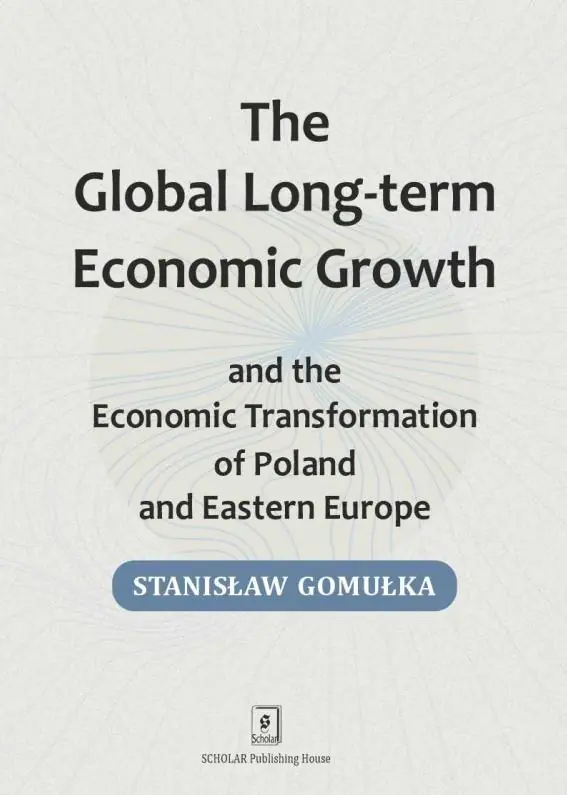
The Global Long-term Economic Growth and the Economic Transformation of Poland and Eastern Europe
Masz tę lub inne książki?
Sprzedaj je u nas

One notable aspect of countries that are in the process of catching up economically is the significant variation in their per capita annual growth rates, which can vary from nearly zero to around 10%. The studies included in this monograph reveal that this growth rate is heavily influenced by factors such as the level of investment, the quality of the workforce, and the nature of institutional frameworks. Investment levels themselves are closely linked to domestic savings rates. In the case of Poland, domestic savings rates have historically been low when compared to global standards. However, the country has experienced a trend growth rate of about 3.7%, surpassing that of the most advanced economies by approximately 2 percentage points. This progress is largely credited to the establishment of modern market institutions, the rise of a vibrant private sector, substantial foreign direct investments, and significant financial inflows from the European Union. On the other hand, Ukraine has seen the least effective transformation in Eastern Europe.The discussion in this monograph is concentrated on the Technology Frontier Area (TFA) globally, framing the central question around how the rate of innovation within this area evolves over time, even across centuries. The analysis suggests that the trajectory of innovation rates over time might assume a hat-like shape. This "Hat-Shape Relationship" is both an empirical observation and a theoretical proposition, predicting innovation dynamics through a model devised by the author. The model aligns the periods of acceleration and consistent growth with historical trends, with the slowdown phase forming the book's main thesis.Stanisław Gomułka, born in 1940 in Poland, holds a Master of Science in theoretical physics, achieved in 1961 with his thesis published in 1964 in the Physical Review. He earned a PhD in economics from the University of Warsaw in 1966 and contributed to the economics department at the London School of Economics from 1970 to 2005. His academic journey also included positions such as visiting professor at Pennsylvania University, and visiting scholar at Harvard, Columbia, and Stanford Universities, coupled with a research fellowship at the Netherlands Institute for Advanced Studies. He served as an advisor to the IMF on Polish matters between 1985 and 1987 and was a pivotal advisor to Polish finance ministers from 1989 to 2002. Since 2013, he has been a member of the Polish Academy of Sciences. Gomułka has authored approximately 100 articles in reputable journals and several key books, the most notable being "Inventive Activity, Diffusion, and the Stages of Economic Growth," "Growth, Innovation and Reform in Eastern Europe," and "The Theory of Technological Change and Economic Growth," focusing on economic growth, innovation, public finance reforms, monetary policies, and comparative economic systems.
Wybierz stan zużycia:
WIĘCEJ O SKALI
One notable aspect of countries that are in the process of catching up economically is the significant variation in their per capita annual growth rates, which can vary from nearly zero to around 10%. The studies included in this monograph reveal that this growth rate is heavily influenced by factors such as the level of investment, the quality of the workforce, and the nature of institutional frameworks. Investment levels themselves are closely linked to domestic savings rates. In the case of Poland, domestic savings rates have historically been low when compared to global standards. However, the country has experienced a trend growth rate of about 3.7%, surpassing that of the most advanced economies by approximately 2 percentage points. This progress is largely credited to the establishment of modern market institutions, the rise of a vibrant private sector, substantial foreign direct investments, and significant financial inflows from the European Union. On the other hand, Ukraine has seen the least effective transformation in Eastern Europe.The discussion in this monograph is concentrated on the Technology Frontier Area (TFA) globally, framing the central question around how the rate of innovation within this area evolves over time, even across centuries. The analysis suggests that the trajectory of innovation rates over time might assume a hat-like shape. This "Hat-Shape Relationship" is both an empirical observation and a theoretical proposition, predicting innovation dynamics through a model devised by the author. The model aligns the periods of acceleration and consistent growth with historical trends, with the slowdown phase forming the book's main thesis.Stanisław Gomułka, born in 1940 in Poland, holds a Master of Science in theoretical physics, achieved in 1961 with his thesis published in 1964 in the Physical Review. He earned a PhD in economics from the University of Warsaw in 1966 and contributed to the economics department at the London School of Economics from 1970 to 2005. His academic journey also included positions such as visiting professor at Pennsylvania University, and visiting scholar at Harvard, Columbia, and Stanford Universities, coupled with a research fellowship at the Netherlands Institute for Advanced Studies. He served as an advisor to the IMF on Polish matters between 1985 and 1987 and was a pivotal advisor to Polish finance ministers from 1989 to 2002. Since 2013, he has been a member of the Polish Academy of Sciences. Gomułka has authored approximately 100 articles in reputable journals and several key books, the most notable being "Inventive Activity, Diffusion, and the Stages of Economic Growth," "Growth, Innovation and Reform in Eastern Europe," and "The Theory of Technological Change and Economic Growth," focusing on economic growth, innovation, public finance reforms, monetary policies, and comparative economic systems.
Szczegóły
Inne książki: Stanisław Gomułka

Podobne produkty
Może Ci się spodobać
Inne książki z tej samej kategorii

Napisz opinię o książce i wygraj nagrodę!
W każdym miesiącu wybieramy najlepsze opinie i nagradzamy recenzentów.
Dowiedz się więcejWartość nagród w tym miesiącu
880 zł
Dodaj swoją opinię
Zaloguj się na swoje konto, aby mieć możliwość dodawania opinii.
Czy chcesz zostawić tylko ocenę?
Dodanie samej oceny o książce nie jest brane pod uwagę podczas losowania nagród. By mieć szansę na otrzymanie nagrody musisz napisać opinię o książce.
Już oceniłeś/zrecenzowałeś te książkę w przeszłości.
Możliwe jest dodanie tylko jednej recenzji do każdej z książek.
Sposoby dostawy
Odbiór w punkcie (6)
InPost Paczkomat 24/7

13,99 zł
ORLEN Paczka

12,99 zł




Dostawa na adres (7)
GLS U Ciebie - Kurier

14,99 zł
Kurier DPD

14,99 zł





Sposoby płatności
Płatność z góry
Przedpłata

Zwykły przelew
