Stan książek
Nasze książki są dokładnie sprawdzone i jasno określamy stan każdej z nich.


Nowa
Książka nowa.
Używany - jak nowa
Niezauważalne lub prawie niezauważalne ślady używania. Książkę ciężko odróżnić od nowej pozycji.
Używany - dobry
Normalne ślady używania wynikające z kartkowania podczas czytania, brak większych uszkodzeń lub zagięć.
Używany - widoczne ślady użytkowania
zagięte rogi, przyniszczona okładka, książka posiada wszystkie strony.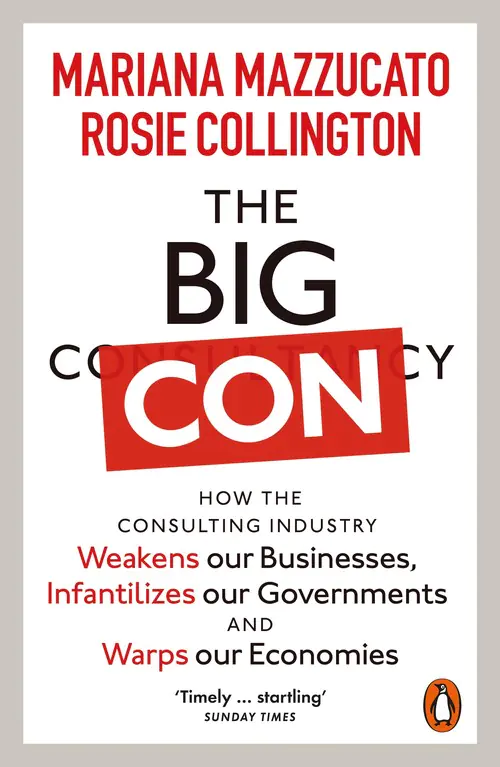
The Big Con
Masz tę lub inne książki?
Sprzedaj je u nas

The book explores the entrenched ties connecting the consulting industry with risk-averse governments and companies focused purely on maximizing shareholder value. Authors Mariana Mazzucato and Rosie Collington argue that reliance on firms like McKinsey, Boston Consulting Group, Bain & Company, PwC, Deloitte, KPMG, and EY can stifle innovation, obscure corporate and political accountability, and hinder efforts to address climate change. The 'Big Con' thrives in modern economies because consultancies have amassed significant influence through extensive contracts and networks, acting as advisors, legitimators, and outsourcing agents, all while maintaining the façade of being neutral experts. This phenomenon weakens businesses, oversimplifies government functions, and distorts economic structures. Mazzucato and Collington thoroughly challenge the widespread belief that consultancies inherently benefit the economy. Through detailed research, they advocate for investing in collective intelligence within organizations and societies and call for a refreshed approach where both public and private entities collaborate creatively for the greater good. The authors urge a redefinition of the consultant's role to rebuild dynamic and effective economies and governments.
Wybierz stan zużycia:
WIĘCEJ O SKALI
The book explores the entrenched ties connecting the consulting industry with risk-averse governments and companies focused purely on maximizing shareholder value. Authors Mariana Mazzucato and Rosie Collington argue that reliance on firms like McKinsey, Boston Consulting Group, Bain & Company, PwC, Deloitte, KPMG, and EY can stifle innovation, obscure corporate and political accountability, and hinder efforts to address climate change. The 'Big Con' thrives in modern economies because consultancies have amassed significant influence through extensive contracts and networks, acting as advisors, legitimators, and outsourcing agents, all while maintaining the façade of being neutral experts. This phenomenon weakens businesses, oversimplifies government functions, and distorts economic structures. Mazzucato and Collington thoroughly challenge the widespread belief that consultancies inherently benefit the economy. Through detailed research, they advocate for investing in collective intelligence within organizations and societies and call for a refreshed approach where both public and private entities collaborate creatively for the greater good. The authors urge a redefinition of the consultant's role to rebuild dynamic and effective economies and governments.
Szczegóły
Inne książki tych autorów

Podobne produkty
Może Ci się spodobać
Inne książki z tej samej kategorii

Napisz opinię o książce i wygraj nagrodę!
W każdym miesiącu wybieramy najlepsze opinie i nagradzamy recenzentów.
Dowiedz się więcejWartość nagród w tym miesiącu
880 zł
Dodaj swoją opinię
Zaloguj się na swoje konto, aby mieć możliwość dodawania opinii.
Czy chcesz zostawić tylko ocenę?
Dodanie samej oceny o książce nie jest brane pod uwagę podczas losowania nagród. By mieć szansę na otrzymanie nagrody musisz napisać opinię o książce.
Już oceniłeś/zrecenzowałeś te książkę w przeszłości.
Możliwe jest dodanie tylko jednej recenzji do każdej z książek.
Sposoby dostawy
Odbiór w punkcie (7)
InPost Paczkomat 24/7

14,99 zł
DPD Pickup Automaty i Punkty Odbioru

11,99 zł





Dostawa na adres (7)
GLS U Ciebie - Kurier

14,99 zł
Kurier DPD

14,99 zł





Sposoby płatności
Płatność z góry
Przedpłata

Zwykły przelew
