Stan książek
Nasze książki są dokładnie sprawdzone i jasno określamy stan każdej z nich.


Nowa
Książka nowa.
Używany - jak nowa
Niezauważalne lub prawie niezauważalne ślady używania. Książkę ciężko odróżnić od nowej pozycji.
Używany - dobry
Normalne ślady używania wynikające z kartkowania podczas czytania, brak większych uszkodzeń lub zagięć.
Używany - widoczne ślady użytkowania
zagięte rogi, przyniszczona okładka, książka posiada wszystkie strony.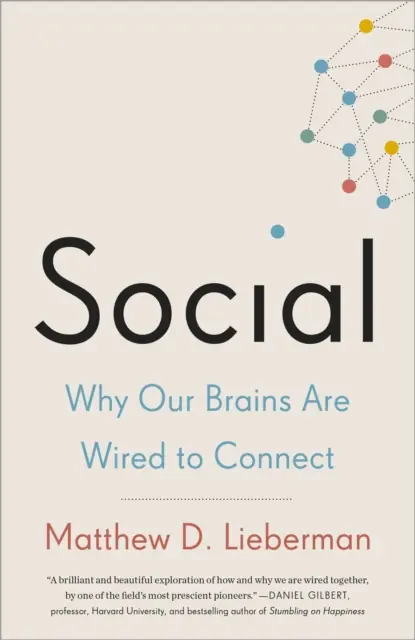
Social
Masz tę lub inne książki?
Sprzedaj je u nas

We are profoundly social beings, often more than we realize. In "Social," the esteemed psychologist Matthew Lieberman delves into exciting research in social neuroscience, demonstrating that our need to connect with others is more fundamental than our basic needs for food or shelter. The brain, during its downtime, focuses on understanding our social environment—other individuals and our connections to them. It is commonly believed that mastering a skill takes about 10,000 hours, but Lieberman suggests that by the age of ten, each of us has already spent those 10,000 hours learning to understand people and social groups.The book asserts that our drive to interact with others significantly influences our behavior. We tend to think that pain and pleasure are the sole motivators of our actions, yet new research utilizing fMRI technology—including substantial work by Lieberman and his team at UCLA—demonstrates that social pain and pleasure affect our brains similarly to physical pain and pleasure. Fortunately, human brains have advanced to develop intricate systems aimed at securing our position in the social sphere. These systems give us the unique ability to understand the perspectives of others, discerning their hopes and fears, which enables us to coordinate our lives effectively. Additionally, our core identity is intricately connected to key individuals and groups in our lives, often prompting us to put our selfish desires aside for the greater good. Although this behavior might seem irrational, it is a product of our deep-rooted social nature, essential for our species' success.This advanced research highlighted in "Social" has significant practical implications. Both educational institutions and businesses often try to limit social interactions, but this approach can be counterproductive, inhibiting engagement and learning by suppressing the social brain and leaving vital cognitive resources underutilized. The insights provided in this groundbreaking book offer strategies to enhance educational outcomes, boost workplace productivity, and improve our overall well-being.
Wybierz stan zużycia:
WIĘCEJ O SKALI
We are profoundly social beings, often more than we realize. In "Social," the esteemed psychologist Matthew Lieberman delves into exciting research in social neuroscience, demonstrating that our need to connect with others is more fundamental than our basic needs for food or shelter. The brain, during its downtime, focuses on understanding our social environment—other individuals and our connections to them. It is commonly believed that mastering a skill takes about 10,000 hours, but Lieberman suggests that by the age of ten, each of us has already spent those 10,000 hours learning to understand people and social groups.The book asserts that our drive to interact with others significantly influences our behavior. We tend to think that pain and pleasure are the sole motivators of our actions, yet new research utilizing fMRI technology—including substantial work by Lieberman and his team at UCLA—demonstrates that social pain and pleasure affect our brains similarly to physical pain and pleasure. Fortunately, human brains have advanced to develop intricate systems aimed at securing our position in the social sphere. These systems give us the unique ability to understand the perspectives of others, discerning their hopes and fears, which enables us to coordinate our lives effectively. Additionally, our core identity is intricately connected to key individuals and groups in our lives, often prompting us to put our selfish desires aside for the greater good. Although this behavior might seem irrational, it is a product of our deep-rooted social nature, essential for our species' success.This advanced research highlighted in "Social" has significant practical implications. Both educational institutions and businesses often try to limit social interactions, but this approach can be counterproductive, inhibiting engagement and learning by suppressing the social brain and leaving vital cognitive resources underutilized. The insights provided in this groundbreaking book offer strategies to enhance educational outcomes, boost workplace productivity, and improve our overall well-being.
Szczegóły
Inne książki: Matthew D. Lieberman

Podobne produkty
Może Ci się spodobać
Inne książki z tej samej kategorii

Napisz opinię o książce i wygraj nagrodę!
W każdym miesiącu wybieramy najlepsze opinie i nagradzamy recenzentów.
Dowiedz się więcejWartość nagród w tym miesiącu
880 zł
Dodaj swoją opinię
Zaloguj się na swoje konto, aby mieć możliwość dodawania opinii.
Czy chcesz zostawić tylko ocenę?
Dodanie samej oceny o książce nie jest brane pod uwagę podczas losowania nagród. By mieć szansę na otrzymanie nagrody musisz napisać opinię o książce.
Już oceniłeś/zrecenzowałeś te książkę w przeszłości.
Możliwe jest dodanie tylko jednej recenzji do każdej z książek.
Sposoby dostawy
Płatne z góry

InPost Paczkomaty 24/7
13.99 zł
Darmowa od 190 zł

ORLEN Paczka
12.99 zł
Darmowa od 190 zł

Automaty DHL BOX 24/7 i punkty POP
12.99 zł
Darmowa od 190 zł

DPD Pickup Automaty i Punkty Odbioru
8.99 zł
Darmowa od 190 zł

Automaty Orlen Paczka, sklepy Żabka i inne
12.99 zł
Darmowa od 190 zł

GLS U Ciebie - Kurier
14.99 zł
Darmowa od 190 zł

Kurier DPD
14.99 zł
Darmowa od 190 zł

Kurier InPost
14.99 zł
Darmowa od 190 zł

Pocztex Kurier
13.99 zł
Darmowa od 190 zł

Kurier DHL
14.99 zł
Darmowa od 190 zł

Kurier GLS - kraje UE
69.00 zł

Punkt odbioru (Dębica)
2.99 zł
Darmowa od 190 zł
Płatne przy odbiorze

Kurier GLS pobranie
23.99 zł
Sposoby płatności
Płatność z góry
Przedpłata

Zwykły przelew
