Stan książek
Nasze książki są dokładnie sprawdzone i jasno określamy stan każdej z nich.


Nowa
Książka nowa.
Używany - jak nowa
Niezauważalne lub prawie niezauważalne ślady używania. Książkę ciężko odróżnić od nowej pozycji.
Używany - dobry
Normalne ślady używania wynikające z kartkowania podczas czytania, brak większych uszkodzeń lub zagięć.
Używany - widoczne ślady użytkowania
zagięte rogi, przyniszczona okładka, książka posiada wszystkie strony.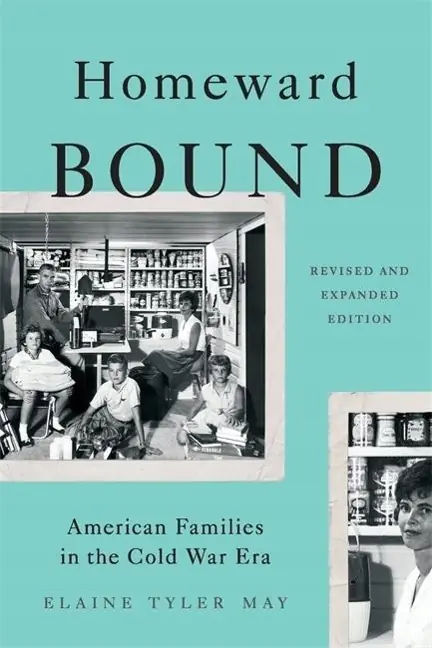
Homeward Bound (Revised Edition)
Masz tę lub inne książki?
Sprzedaj je u nas

When "Homeward Bound" was published in 1988, it significantly reshaped perceptions of Cold War-era America. Previously, the era following World War II had been viewed as a period when Americans distanced themselves from political engagement, choosing instead to bask in the newfound tranquility and prosperity after years of war and economic hardship. During this time, leaders were seen as primarily concerned with the looming Soviet threat and the challenges of the Atomic Age. "Homeward Bound" contested the notion of a solely private, apolitical sphere, revealing how the Atomic Age and Cold War deeply permeated all facets of American life, from corporate settings to intimate personal spaces.Elaine Tyler May posits that the nation's foreign policy of "containment" towards the Soviet Union had a parallel within domestic life. The impending threats of the day—nuclear conflict, communist infiltration, consumerism, sexual liberation, and women's rights—were to be managed within the confines of the family. The family unit thus became the epicenter for achieving dreams of security and a fulfilling life amidst global uncertainty. This idea of "domestic containment" has since become the prevailing interpretation of the era, and "Homeward Bound" is now regarded as a seminal work.This edition of the book offers an updated introduction and a new epilogue, exploring how the Cold War’s fixation on personal and familial security continues to influence current times.
Wybierz stan zużycia:
WIĘCEJ O SKALI
When "Homeward Bound" was published in 1988, it significantly reshaped perceptions of Cold War-era America. Previously, the era following World War II had been viewed as a period when Americans distanced themselves from political engagement, choosing instead to bask in the newfound tranquility and prosperity after years of war and economic hardship. During this time, leaders were seen as primarily concerned with the looming Soviet threat and the challenges of the Atomic Age. "Homeward Bound" contested the notion of a solely private, apolitical sphere, revealing how the Atomic Age and Cold War deeply permeated all facets of American life, from corporate settings to intimate personal spaces.Elaine Tyler May posits that the nation's foreign policy of "containment" towards the Soviet Union had a parallel within domestic life. The impending threats of the day—nuclear conflict, communist infiltration, consumerism, sexual liberation, and women's rights—were to be managed within the confines of the family. The family unit thus became the epicenter for achieving dreams of security and a fulfilling life amidst global uncertainty. This idea of "domestic containment" has since become the prevailing interpretation of the era, and "Homeward Bound" is now regarded as a seminal work.This edition of the book offers an updated introduction and a new epilogue, exploring how the Cold War’s fixation on personal and familial security continues to influence current times.
Szczegóły
Inne książki tych autorów

Podobne produkty
Może Ci się spodobać
Inne książki z tej samej kategorii

Napisz opinię o książce i wygraj nagrodę!
W każdym miesiącu wybieramy najlepsze opinie i nagradzamy recenzentów.
Dowiedz się więcejWartość nagród w tym miesiącu
880 zł
Dodaj swoją opinię
Zaloguj się na swoje konto, aby mieć możliwość dodawania opinii.
Czy chcesz zostawić tylko ocenę?
Dodanie samej oceny o książce nie jest brane pod uwagę podczas losowania nagród. By mieć szansę na otrzymanie nagrody musisz napisać opinię o książce.
Już oceniłeś/zrecenzowałeś te książkę w przeszłości.
Możliwe jest dodanie tylko jednej recenzji do każdej z książek.
Sposoby dostawy
Odbiór w punkcie (7)
InPost Paczkomat 24/7

14,99 zł
DPD Pickup Automaty i Punkty Odbioru

11,99 zł





Dostawa na adres (7)
GLS U Ciebie - Kurier

14,99 zł
Kurier DPD

14,99 zł





Sposoby płatności
Płatność z góry
Przedpłata

Zwykły przelew
