Stan książek
Nasze książki są dokładnie sprawdzone i jasno określamy stan każdej z nich.


Nowa
Książka nowa.
Używany - jak nowa
Niezauważalne lub prawie niezauważalne ślady używania. Książkę ciężko odróżnić od nowej pozycji.
Używany - dobry
Normalne ślady używania wynikające z kartkowania podczas czytania, brak większych uszkodzeń lub zagięć.
Używany - widoczne ślady użytkowania
zagięte rogi, przyniszczona okładka, książka posiada wszystkie strony.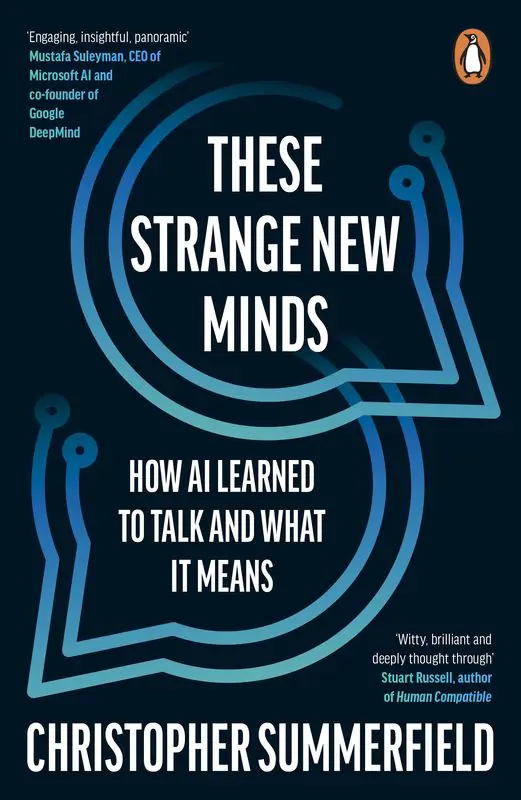
These Strange New Minds
Masz tę lub inne książki?
Sprzedaj je u nas

Mustafa Suleyman, the CEO of Microsoft AI and Co-founder of DeepMind, described the landscape of digital technology as 'engaging, insightful, and panoramic.' The remarkable progress in digital technology has like never before introduced human-like AI systems. Platforms such as ChatGPT, Claude, and Gemini are already changing economic structures, challenging democratic processes, and altering societal norms in unpredicted manners. These AI systems are poised to soon make autonomous decisions on behalf of users, fundamentally changing our daily activities. Understanding these systems is vital. Can AI truly think, comprehend, or possess knowledge? Might they have the ability to manipulate or deceive, and if so, how might they influence you? Whose interests do they actually serve? At what point could they transcend verbal communication to take real-world actions? Neuroscientist and AI researcher Christopher Summerfield delves into these issues, tracing AI’s trajectory from early theoretical propositions in the seventeenth century to the contemporary era of deep neural networks. His book offers an easily digestible, current, and authoritative analysis of this transformative technology. By grasping AI’s inner mechanics, we can tackle the major existential inquiry of our time: are we heading towards a technological utopia, or are we inadvertently writing ourselves out of history?
Wybierz stan zużycia:
WIĘCEJ O SKALI
Mustafa Suleyman, the CEO of Microsoft AI and Co-founder of DeepMind, described the landscape of digital technology as 'engaging, insightful, and panoramic.' The remarkable progress in digital technology has like never before introduced human-like AI systems. Platforms such as ChatGPT, Claude, and Gemini are already changing economic structures, challenging democratic processes, and altering societal norms in unpredicted manners. These AI systems are poised to soon make autonomous decisions on behalf of users, fundamentally changing our daily activities. Understanding these systems is vital. Can AI truly think, comprehend, or possess knowledge? Might they have the ability to manipulate or deceive, and if so, how might they influence you? Whose interests do they actually serve? At what point could they transcend verbal communication to take real-world actions? Neuroscientist and AI researcher Christopher Summerfield delves into these issues, tracing AI’s trajectory from early theoretical propositions in the seventeenth century to the contemporary era of deep neural networks. His book offers an easily digestible, current, and authoritative analysis of this transformative technology. By grasping AI’s inner mechanics, we can tackle the major existential inquiry of our time: are we heading towards a technological utopia, or are we inadvertently writing ourselves out of history?
Szczegóły
Inne książki: Summerfield Christopher

Podobne produkty
Może Ci się spodobać
Inne książki z tej samej kategorii

Napisz opinię o książce i wygraj nagrodę!
W każdym miesiącu wybieramy najlepsze opinie i nagradzamy recenzentów.
Dowiedz się więcejWartość nagród w tym miesiącu
880 zł
Dodaj swoją opinię
Zaloguj się na swoje konto, aby mieć możliwość dodawania opinii.
Czy chcesz zostawić tylko ocenę?
Dodanie samej oceny o książce nie jest brane pod uwagę podczas losowania nagród. By mieć szansę na otrzymanie nagrody musisz napisać opinię o książce.
Już oceniłeś/zrecenzowałeś te książkę w przeszłości.
Możliwe jest dodanie tylko jednej recenzji do każdej z książek.
Sposoby dostawy
Odbiór w punkcie (7)
InPost Paczkomat 24/7

14,99 zł
DPD Pickup Automaty i Punkty Odbioru

11,99 zł





Dostawa na adres (7)
GLS U Ciebie - Kurier

14,99 zł
Kurier DPD

14,99 zł





Sposoby płatności
Płatność z góry
Przedpłata

Zwykły przelew
