Stan książek
Nasze książki są dokładnie sprawdzone i jasno określamy stan każdej z nich.


Nowa
Książka nowa.
Używany - jak nowa
Niezauważalne lub prawie niezauważalne ślady używania. Książkę ciężko odróżnić od nowej pozycji.
Używany - dobry
Normalne ślady używania wynikające z kartkowania podczas czytania, brak większych uszkodzeń lub zagięć.
Używany - widoczne ślady użytkowania
zagięte rogi, przyniszczona okładka, książka posiada wszystkie strony.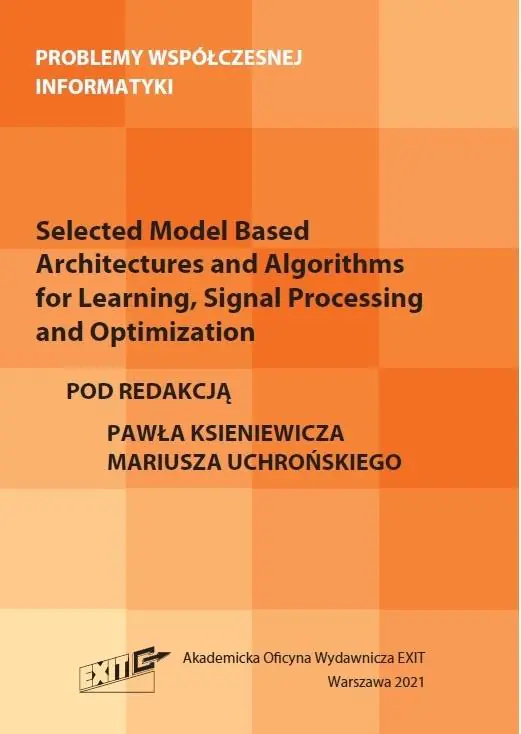
Selected Model Based Architectures and Algorithms for Learning, Signal Processing and Optimization. Problemy współczesnej informatyki
Masz tę lub inne książki?
Sprzedaj je u nas

The document provides a detailed overview of several advanced topics surrounding both theoretical and applied aspects in various technical fields. It begins with exploring Schur Parametrization and the orthogonal modeling of p-stationary second-order stochastic processes, which are complex mathematical concepts used in signal processing and data analysis. It then moves on to discuss efficient Direction of Arrival (DOA) algorithms that utilize multi-dimensional high-resolution Fourier transforms, essential for improving signal directionality in communication systems.Further, the document delves into wireless localization systems, underscoring their importance in determining precise geographic locations via wireless signals. An important contribution is outlined towards generating Palladio performance models using Platform-Independent Model (PIM) and Platform-Specific Model (PSM) frameworks, enhancing software architecture analysis.The architecture of dependency-noise ensemble for statistical-based diversification in multiple classifier systems is analyzed, showing how noise management can improve machine learning models. An innovative model of active noise reduction systems that employs adaptive filtering algorithms in automotive technologies is also presented, indicating advances in vehicle noise management.A new approach to developing and designing neural network-based ensembles is introduced, offering insights into how artificial intelligence can be harnessed for various computational tasks. A model-based scheduling algorithm is proposed for streamlining the transport and assembly in construction processes, suggesting improvements in operational efficiency. Lastly, the document explores preference falsification through Monte Carlo simulations using an agent-based model with a Hamiltonian, providing insights into decision-making processes in complex systems.
Wybierz stan zużycia:
WIĘCEJ O SKALI
The document provides a detailed overview of several advanced topics surrounding both theoretical and applied aspects in various technical fields. It begins with exploring Schur Parametrization and the orthogonal modeling of p-stationary second-order stochastic processes, which are complex mathematical concepts used in signal processing and data analysis. It then moves on to discuss efficient Direction of Arrival (DOA) algorithms that utilize multi-dimensional high-resolution Fourier transforms, essential for improving signal directionality in communication systems.Further, the document delves into wireless localization systems, underscoring their importance in determining precise geographic locations via wireless signals. An important contribution is outlined towards generating Palladio performance models using Platform-Independent Model (PIM) and Platform-Specific Model (PSM) frameworks, enhancing software architecture analysis.The architecture of dependency-noise ensemble for statistical-based diversification in multiple classifier systems is analyzed, showing how noise management can improve machine learning models. An innovative model of active noise reduction systems that employs adaptive filtering algorithms in automotive technologies is also presented, indicating advances in vehicle noise management.A new approach to developing and designing neural network-based ensembles is introduced, offering insights into how artificial intelligence can be harnessed for various computational tasks. A model-based scheduling algorithm is proposed for streamlining the transport and assembly in construction processes, suggesting improvements in operational efficiency. Lastly, the document explores preference falsification through Monte Carlo simulations using an agent-based model with a Hamiltonian, providing insights into decision-making processes in complex systems.
Szczegóły
Inne książki tych autorów

Podobne produkty
Może Ci się spodobać
Inne książki z tej samej kategorii

Napisz opinię o książce i wygraj nagrodę!
W każdym miesiącu wybieramy najlepsze opinie i nagradzamy recenzentów.
Dowiedz się więcejWartość nagród w tym miesiącu
880 zł
Dodaj swoją opinię
Zaloguj się na swoje konto, aby mieć możliwość dodawania opinii.
Czy chcesz zostawić tylko ocenę?
Dodanie samej oceny o książce nie jest brane pod uwagę podczas losowania nagród. By mieć szansę na otrzymanie nagrody musisz napisać opinię o książce.
Już oceniłeś/zrecenzowałeś te książkę w przeszłości.
Możliwe jest dodanie tylko jednej recenzji do każdej z książek.
Sposoby dostawy
Odbiór w punkcie (6)
InPost Paczkomat 24/7

13,99 zł
ORLEN Paczka

12,99 zł




Dostawa na adres (7)
GLS U Ciebie - Kurier

14,99 zł
Kurier DPD

14,99 zł





Sposoby płatności
Płatność z góry
Przedpłata

Zwykły przelew
