Stan książek
Nasze książki są dokładnie sprawdzone i jasno określamy stan każdej z nich.

Nowa
Książka nowa.
Używany - jak nowa
Niezauważalne lub prawie niezauważalne ślady używania. Książkę ciężko odróżnić od nowej pozycji.
Używany - dobry
Normalne ślady używania wynikające z kartkowania podczas czytania, brak większych uszkodzeń lub zagięć.
Używany - widoczne ślady użytkowania
zagięte rogi, przyniszczona okładka, książka posiada wszystkie strony.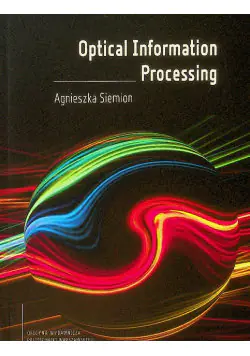
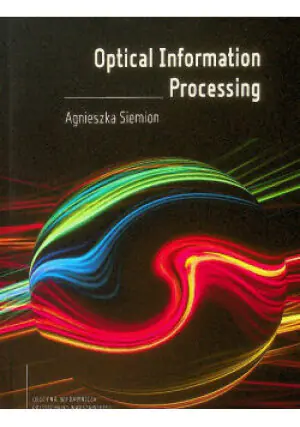
Optical Information Processing
Masz tę lub inne książki?
Sprzedaj je u nas

The text presents the essential materials for Optical Information Processing laboratory sessions at the Faculty of Physics, Warsaw University of Technology. These sessions complement lectures and workshops by offering practical applications that deepen understanding. The course includes seven laboratory exercises that provide hands-on experience in holography, optical setups, and numerical simulations, focusing on important aspects of optical information processing for a thorough grasp of both theory and practice.These experiments are especially advantageous for students specializing in optics and photonics, as they are crafted as advanced laboratory tasks. Initial exercises cover interferometry and holography, crucial techniques for precise surface analysis and deformation studies. Holography, in particular, is a precise method for visualizing micro changes and detecting internal flaws.Following these, students explore the basics of angular spectrum operations via spatial filtering, correlation observation, and Fourier hologram recording. A solid understanding of image processing in the frequency domain is essential for effectively managing optical setups and numerical algorithms.In the penultimate session, students model optical setups numerically, focusing on the differences between discrete and continuous signal processing. Mastery of the sampling theorem is crucial for accurately designing optical signals.The final laboratory exercise involves designing and creating holograms that can be reconstructed using white light. This series of exercises aims to enhance students' understanding of optical signal processing, consolidating their cumulative learning. The text is authored by Agnieszka Siemion and published by Oficyna Wydawnicza Politechniki Warszawskiej.
Wybierz stan zużycia:
WIĘCEJ O SKALI
The text presents the essential materials for Optical Information Processing laboratory sessions at the Faculty of Physics, Warsaw University of Technology. These sessions complement lectures and workshops by offering practical applications that deepen understanding. The course includes seven laboratory exercises that provide hands-on experience in holography, optical setups, and numerical simulations, focusing on important aspects of optical information processing for a thorough grasp of both theory and practice.These experiments are especially advantageous for students specializing in optics and photonics, as they are crafted as advanced laboratory tasks. Initial exercises cover interferometry and holography, crucial techniques for precise surface analysis and deformation studies. Holography, in particular, is a precise method for visualizing micro changes and detecting internal flaws.Following these, students explore the basics of angular spectrum operations via spatial filtering, correlation observation, and Fourier hologram recording. A solid understanding of image processing in the frequency domain is essential for effectively managing optical setups and numerical algorithms.In the penultimate session, students model optical setups numerically, focusing on the differences between discrete and continuous signal processing. Mastery of the sampling theorem is crucial for accurately designing optical signals.The final laboratory exercise involves designing and creating holograms that can be reconstructed using white light. This series of exercises aims to enhance students' understanding of optical signal processing, consolidating their cumulative learning. The text is authored by Agnieszka Siemion and published by Oficyna Wydawnicza Politechniki Warszawskiej.
Szczegóły

Inne książki tych autorów

Podobne produkty
Może Ci się spodobać
Inne książki z tej samej kategorii

Napisz opinię o książce i wygraj nagrodę!
W każdym miesiącu wybieramy najlepsze opinie i nagradzamy recenzentów.
Dowiedz się więcejWartość nagród w tym miesiącu
880 zł
Dodaj swoją opinię
Zaloguj się na swoje konto, aby mieć możliwość dodawania opinii.
Czy chcesz zostawić tylko ocenę?
Dodanie samej oceny o książce nie jest brane pod uwagę podczas losowania nagród. By mieć szansę na otrzymanie nagrody musisz napisać opinię o książce.
Już oceniłeś/zrecenzowałeś te książkę w przeszłości.
Możliwe jest dodanie tylko jednej recenzji do każdej z książek.
Sposoby dostawy
Odbiór w punkcie (6)
InPost Paczkomat 24/7

13,99 zł
ORLEN Paczka

12,99 zł



Dostawa na adres (7)
GLS U Ciebie - Kurier

14,99 zł
Kurier DPD

14,99 zł





Sposoby płatności
Płatność z góry
Przedpłata

Zwykły przelew
