Stan książek
Nasze książki są dokładnie sprawdzone i jasno określamy stan każdej z nich.


Nowa
Książka nowa.
Używany - jak nowa
Niezauważalne lub prawie niezauważalne ślady używania. Książkę ciężko odróżnić od nowej pozycji.
Używany - dobry
Normalne ślady używania wynikające z kartkowania podczas czytania, brak większych uszkodzeń lub zagięć.
Używany - widoczne ślady użytkowania
zagięte rogi, przyniszczona okładka, książka posiada wszystkie strony.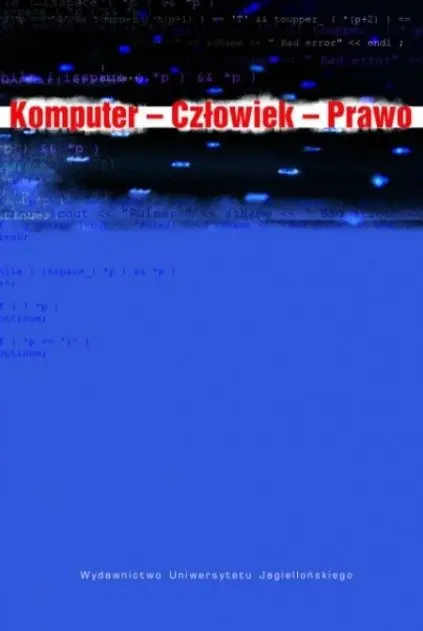
KOMPUTER CZŁOWIEK PRAWO
Masz tę lub inne książki?
Sprzedaj je u nas

The Faculty of Management and Social Communication was established in 1996 as an inherently interdisciplinary entity. It has evolved into one of the largest faculties at Jagiellonian University, encompassing seven institutes, two independent departments, and nearly 5,500 students. Despite its growth, the faculty remains committed to its founding principles, offering a collaborative platform for research and education across economic, humanistic, legal, and computer sciences. This approach facilitates the examination of management and social communication issues from diverse perspectives. Consequently, the content of the volume, where faculty specialists from various disciplines provide their analysis on information-related issues and modern information management tools such as the Internet and advanced computer systems, should come as no surprise. Furthermore, the authors have consciously chosen, whenever possible, to forgo technical jargon specific to their fields, aiming to communicate their insights in a way that is accessible to all.
Wybierz stan zużycia:
WIĘCEJ O SKALI
The Faculty of Management and Social Communication was established in 1996 as an inherently interdisciplinary entity. It has evolved into one of the largest faculties at Jagiellonian University, encompassing seven institutes, two independent departments, and nearly 5,500 students. Despite its growth, the faculty remains committed to its founding principles, offering a collaborative platform for research and education across economic, humanistic, legal, and computer sciences. This approach facilitates the examination of management and social communication issues from diverse perspectives. Consequently, the content of the volume, where faculty specialists from various disciplines provide their analysis on information-related issues and modern information management tools such as the Internet and advanced computer systems, should come as no surprise. Furthermore, the authors have consciously chosen, whenever possible, to forgo technical jargon specific to their fields, aiming to communicate their insights in a way that is accessible to all.
Szczegóły
Dane producenta:
Inne książki tych autorów

Podobne produkty
Może Ci się spodobać
Inne książki z tej samej kategorii

Napisz opinię o książce i wygraj nagrodę!
W każdym miesiącu wybieramy najlepsze opinie i nagradzamy recenzentów.
Dowiedz się więcejWartość nagród w tym miesiącu
880 zł
Dodaj swoją opinię
Zaloguj się na swoje konto, aby mieć możliwość dodawania opinii.
Czy chcesz zostawić tylko ocenę?
Dodanie samej oceny o książce nie jest brane pod uwagę podczas losowania nagród. By mieć szansę na otrzymanie nagrody musisz napisać opinię o książce.
Już oceniłeś/zrecenzowałeś te książkę w przeszłości.
Możliwe jest dodanie tylko jednej recenzji do każdej z książek.
Sposoby dostawy
Odbiór w punkcie (6)
InPost Paczkomat 24/7

13,99 zł
ORLEN Paczka

12,99 zł




Dostawa na adres (7)
GLS U Ciebie - Kurier

14,99 zł
Kurier DPD

14,99 zł





Sposoby płatności
Płatność z góry
Przedpłata

Zwykły przelew
