Stan książek
Nasze książki są dokładnie sprawdzone i jasno określamy stan każdej z nich.


Nowa
Książka nowa.
Używany - jak nowa
Niezauważalne lub prawie niezauważalne ślady używania. Książkę ciężko odróżnić od nowej pozycji.
Używany - dobry
Normalne ślady używania wynikające z kartkowania podczas czytania, brak większych uszkodzeń lub zagięć.
Używany - widoczne ślady użytkowania
zagięte rogi, przyniszczona okładka, książka posiada wszystkie strony.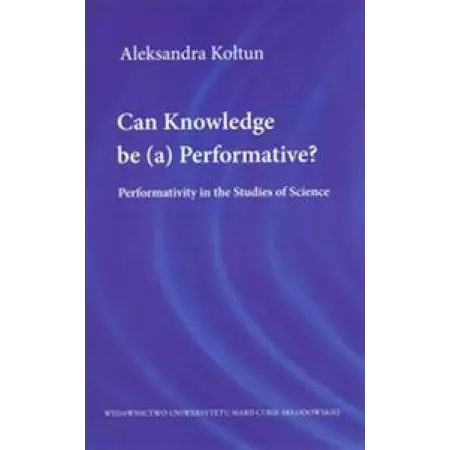
Can Knowledge be (a) Performative?
Masz tę lub inne książki?
Sprzedaj je u nas

The growing interest in the concepts of performance and performativity has sparked a renewed focus on their potential value for modern approaches to knowledge creation. Drawing inspiration from various fields such as performance studies, philosophy of language, literary theory, gender studies, and postconstructivist science and technology studies, the author suggests exploring knowledge from the perspective of its performative nature. The notion of "knowledge as performative" highlights the deeply transformative and contextually rooted aspect of knowledge, which is seen both as an outcome and an ongoing process. This perspective emphasizes its open-ended, dynamic, fleeting, and multifaceted characteristics, its active involvement with the world, and its interactions within power structures, lacking straightforward paths or easily quantifiable results. Thus, adopting the idea of knowledge as performative necessitates changes in both the descriptive language and the central issues addressed. These changes primarily concern the nature and environments of knowledge production, the broadly defined concept of effectiveness, the interplay with power and ethics, and the overarching question of defining the role of science in contemporary society.
Wybierz stan zużycia:
WIĘCEJ O SKALI
The growing interest in the concepts of performance and performativity has sparked a renewed focus on their potential value for modern approaches to knowledge creation. Drawing inspiration from various fields such as performance studies, philosophy of language, literary theory, gender studies, and postconstructivist science and technology studies, the author suggests exploring knowledge from the perspective of its performative nature. The notion of "knowledge as performative" highlights the deeply transformative and contextually rooted aspect of knowledge, which is seen both as an outcome and an ongoing process. This perspective emphasizes its open-ended, dynamic, fleeting, and multifaceted characteristics, its active involvement with the world, and its interactions within power structures, lacking straightforward paths or easily quantifiable results. Thus, adopting the idea of knowledge as performative necessitates changes in both the descriptive language and the central issues addressed. These changes primarily concern the nature and environments of knowledge production, the broadly defined concept of effectiveness, the interplay with power and ethics, and the overarching question of defining the role of science in contemporary society.
Szczegóły
Inne książki: Aleksandra Kołtun

Podobne produkty
Może Ci się spodobać
Inne książki z tej samej kategorii

Napisz opinię o książce i wygraj nagrodę!
W każdym miesiącu wybieramy najlepsze opinie i nagradzamy recenzentów.
Dowiedz się więcejWartość nagród w tym miesiącu
880 zł
Dodaj swoją opinię
Zaloguj się na swoje konto, aby mieć możliwość dodawania opinii.
Czy chcesz zostawić tylko ocenę?
Dodanie samej oceny o książce nie jest brane pod uwagę podczas losowania nagród. By mieć szansę na otrzymanie nagrody musisz napisać opinię o książce.
Już oceniłeś/zrecenzowałeś te książkę w przeszłości.
Możliwe jest dodanie tylko jednej recenzji do każdej z książek.
Sposoby dostawy
Odbiór w punkcie (7)
InPost Paczkomat 24/7

14,99 zł
DPD Pickup Automaty i Punkty Odbioru

10,49 zł





Dostawa na adres (7)
GLS U Ciebie - Kurier

14,99 zł
Kurier DPD

14,99 zł





Sposoby płatności
Płatność z góry
Przedpłata

Zwykły przelew
