Stan książek
Nasze książki są dokładnie sprawdzone i jasno określamy stan każdej z nich.


Nowa
Książka nowa.
Używany - jak nowa
Niezauważalne lub prawie niezauważalne ślady używania. Książkę ciężko odróżnić od nowej pozycji.
Używany - dobry
Normalne ślady używania wynikające z kartkowania podczas czytania, brak większych uszkodzeń lub zagięć.
Używany - widoczne ślady użytkowania
zagięte rogi, przyniszczona okładka, książka posiada wszystkie strony.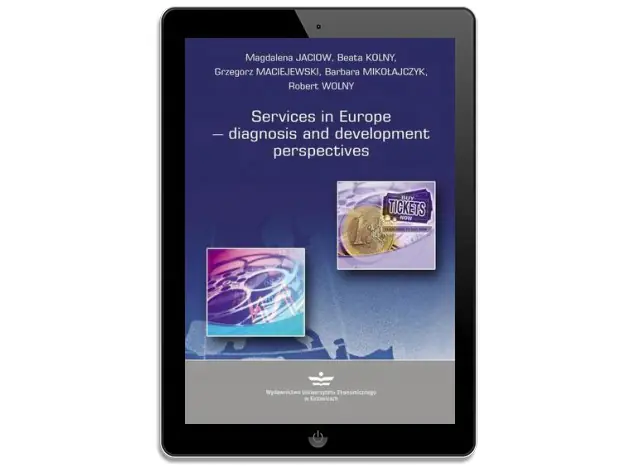
Services in Europe – diagnosis and development perspectives
Masz tę lub inne książki?
Sprzedaj je u nas

Currently, services make up more than half of the total value added in the global economy. In economically advanced nations such as France, the United Kingdom, Italy, and Luxembourg, this percentage reaches between 82% and 85%. A similar trend is observed in the United States. Meanwhile, in the rapidly growing Chinese economy, the proportion is lower but still stands at 50%. In countries like Poland, the Czech Republic, and Hungary, services account for between 60% and 70% of the economy. Although services currently represent a quarter of global exports, forecasts suggest that they will represent half of global economic turnover within the next 10 to 20 years, driven by rapid advancements in financial, IT, and telecommunication services.This monograph aims to explore the current state of the service market in select European countries, analyze the factors influencing these markets, and outline the expected trajectory of the service sector in Europe leading up to 2020. The analysis is grounded in both field and desk research, drawing from Polish and international literature, statistical data, and research reports from 2008 to 2013, with insights extended to 2014 where feasible. This comprehensive approach delineates the condition and dynamics of service economies in Europe and identifies key determinants affecting their operation.The data underwent a quantitative and qualitative analysis employing relevant indicators. Field research was carried out in 2014, featuring surveys among residents of Belgium, Finland, France, Germany, Poland, Romania, Slovakia, and Hungary, alongside expert opinions gathered from academics and practitioners. A non-random, targeted sampling method was employed, focusing on service consumers for quantitative insights and experts for qualitative forecasting based on their knowledge and expertise.This publication is a valuable resource for those involved with the service industry, including service business managers, researchers, and students, who will find its insights particularly useful in understanding the complexities and future directions of the service sector.
Wybierz stan zużycia:
WIĘCEJ O SKALI
Currently, services make up more than half of the total value added in the global economy. In economically advanced nations such as France, the United Kingdom, Italy, and Luxembourg, this percentage reaches between 82% and 85%. A similar trend is observed in the United States. Meanwhile, in the rapidly growing Chinese economy, the proportion is lower but still stands at 50%. In countries like Poland, the Czech Republic, and Hungary, services account for between 60% and 70% of the economy. Although services currently represent a quarter of global exports, forecasts suggest that they will represent half of global economic turnover within the next 10 to 20 years, driven by rapid advancements in financial, IT, and telecommunication services.This monograph aims to explore the current state of the service market in select European countries, analyze the factors influencing these markets, and outline the expected trajectory of the service sector in Europe leading up to 2020. The analysis is grounded in both field and desk research, drawing from Polish and international literature, statistical data, and research reports from 2008 to 2013, with insights extended to 2014 where feasible. This comprehensive approach delineates the condition and dynamics of service economies in Europe and identifies key determinants affecting their operation.The data underwent a quantitative and qualitative analysis employing relevant indicators. Field research was carried out in 2014, featuring surveys among residents of Belgium, Finland, France, Germany, Poland, Romania, Slovakia, and Hungary, alongside expert opinions gathered from academics and practitioners. A non-random, targeted sampling method was employed, focusing on service consumers for quantitative insights and experts for qualitative forecasting based on their knowledge and expertise.This publication is a valuable resource for those involved with the service industry, including service business managers, researchers, and students, who will find its insights particularly useful in understanding the complexities and future directions of the service sector.
Szczegóły
Inne książki tych autorów

Podobne produkty
Może Ci się spodobać
Inne książki z tej samej kategorii

Napisz opinię o książce i wygraj nagrodę!
W każdym miesiącu wybieramy najlepsze opinie i nagradzamy recenzentów.
Dowiedz się więcejWartość nagród w tym miesiącu
880 zł
Dodaj swoją opinię
Zaloguj się na swoje konto, aby mieć możliwość dodawania opinii.
Czy chcesz zostawić tylko ocenę?
Dodanie samej oceny o książce nie jest brane pod uwagę podczas losowania nagród. By mieć szansę na otrzymanie nagrody musisz napisać opinię o książce.
Już oceniłeś/zrecenzowałeś te książkę w przeszłości.
Możliwe jest dodanie tylko jednej recenzji do każdej z książek.
Sposoby dostawy
Odbiór w punkcie (7)
InPost Paczkomat 24/7

14,99 zł
DPD Pickup Automaty i Punkty Odbioru

10,49 zł





Dostawa na adres (7)
GLS U Ciebie - Kurier

14,99 zł
Kurier DPD

14,99 zł





Sposoby płatności
Płatność z góry
Przedpłata

Zwykły przelew
