Stan książek
Nasze książki są dokładnie sprawdzone i jasno określamy stan każdej z nich.


Nowa
Książka nowa.
Używany - jak nowa
Niezauważalne lub prawie niezauważalne ślady używania. Książkę ciężko odróżnić od nowej pozycji.
Używany - dobry
Normalne ślady używania wynikające z kartkowania podczas czytania, brak większych uszkodzeń lub zagięć.
Używany - widoczne ślady użytkowania
zagięte rogi, przyniszczona okładka, książka posiada wszystkie strony.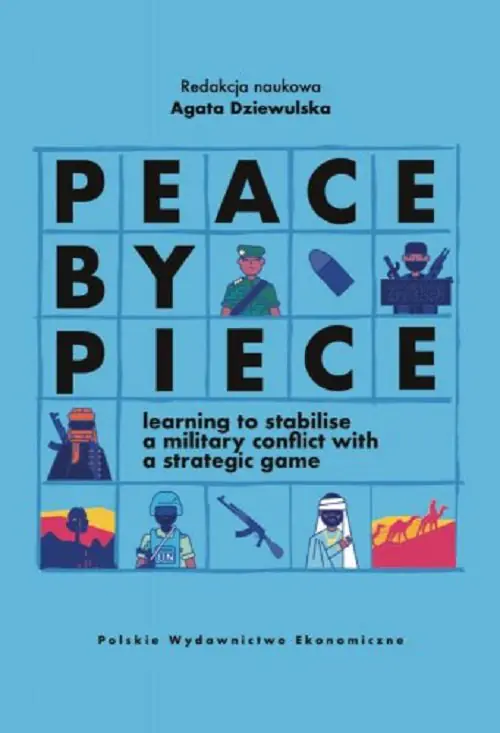
Peace by Piece learning to stabilise a military conflict with a strategic game
Masz tę lub inne książki?
Sprzedaj je u nas

The book is divided into three main sections. The initial section lays out a detailed plan for research and implementation. It begins by exploring the motivation that fueled our scientific interest and led us to develop a project focused on stabilizing armed conflicts through the creation of a strategic simulation game. In this section, we detail the process of conceptualizing the idea and testing our initial hypotheses. Following this, the book provides a broad overview of the theoretical framework that underpinned our focused work, before bringing together the key components crucial for reconstructing a state after conflict into a cohesive concept. Additionally, this part includes a discussion on the history of Mali, serving as a practical example and analytical case study for testing our theoretical approaches.The second section is the most comprehensive part of the book. It encompasses the results of our individual efforts, emphasizing the synthesis of theoretical insights from our respective fields to make them applicable to the development of the strategic game. Building on the theoretical foundation established through dialogue in the first section, we divide the work into different domains, each with its own in-depth study. This section effectively summarizes distinct analyses concerning the political, military, economic, and social aspects of peacebuilding processes. We also highlight the significance of information and infrastructure in the (re)construction of a state.In the final section, the theoretical discussions are integrated with a strategic board game, demonstrating the practical application of the theories discussed earlier. This part describes the outcomes of the game and provides a reflective analysis of the project as a whole. It reveals our findings from the gameplay and insights drawn from observing participant behavior. We've attempted to pose sub-questions that, while not fully developed as research questions, aim to explore how the game could be used to address uncertainties identified during our theoretical work. We view both the book and the game as an ongoing project.
Wybierz stan zużycia:
WIĘCEJ O SKALI
The book is divided into three main sections. The initial section lays out a detailed plan for research and implementation. It begins by exploring the motivation that fueled our scientific interest and led us to develop a project focused on stabilizing armed conflicts through the creation of a strategic simulation game. In this section, we detail the process of conceptualizing the idea and testing our initial hypotheses. Following this, the book provides a broad overview of the theoretical framework that underpinned our focused work, before bringing together the key components crucial for reconstructing a state after conflict into a cohesive concept. Additionally, this part includes a discussion on the history of Mali, serving as a practical example and analytical case study for testing our theoretical approaches.The second section is the most comprehensive part of the book. It encompasses the results of our individual efforts, emphasizing the synthesis of theoretical insights from our respective fields to make them applicable to the development of the strategic game. Building on the theoretical foundation established through dialogue in the first section, we divide the work into different domains, each with its own in-depth study. This section effectively summarizes distinct analyses concerning the political, military, economic, and social aspects of peacebuilding processes. We also highlight the significance of information and infrastructure in the (re)construction of a state.In the final section, the theoretical discussions are integrated with a strategic board game, demonstrating the practical application of the theories discussed earlier. This part describes the outcomes of the game and provides a reflective analysis of the project as a whole. It reveals our findings from the gameplay and insights drawn from observing participant behavior. We've attempted to pose sub-questions that, while not fully developed as research questions, aim to explore how the game could be used to address uncertainties identified during our theoretical work. We view both the book and the game as an ongoing project.
Szczegóły
Inne książki tych autorów

Podobne produkty
Może Ci się spodobać
Inne książki z tej samej kategorii

Napisz opinię o książce i wygraj nagrodę!
W każdym miesiącu wybieramy najlepsze opinie i nagradzamy recenzentów.
Dowiedz się więcejWartość nagród w tym miesiącu
880 zł
Dodaj swoją opinię
Zaloguj się na swoje konto, aby mieć możliwość dodawania opinii.
Czy chcesz zostawić tylko ocenę?
Dodanie samej oceny o książce nie jest brane pod uwagę podczas losowania nagród. By mieć szansę na otrzymanie nagrody musisz napisać opinię o książce.
Już oceniłeś/zrecenzowałeś te książkę w przeszłości.
Możliwe jest dodanie tylko jednej recenzji do każdej z książek.
Sposoby dostawy
Odbiór w punkcie (7)
InPost Paczkomat 24/7

14,99 zł
DPD Pickup Automaty i Punkty Odbioru

10,49 zł





Dostawa na adres (7)
GLS U Ciebie - Kurier

14,99 zł
Kurier DPD

14,99 zł





Sposoby płatności
Płatność z góry
Przedpłata

Zwykły przelew
