Stan książek
Nasze książki są dokładnie sprawdzone i jasno określamy stan każdej z nich.


Nowa
Książka nowa.
Używany - jak nowa
Niezauważalne lub prawie niezauważalne ślady używania. Książkę ciężko odróżnić od nowej pozycji.
Używany - dobry
Normalne ślady używania wynikające z kartkowania podczas czytania, brak większych uszkodzeń lub zagięć.
Używany - widoczne ślady użytkowania
zagięte rogi, przyniszczona okładka, książka posiada wszystkie strony.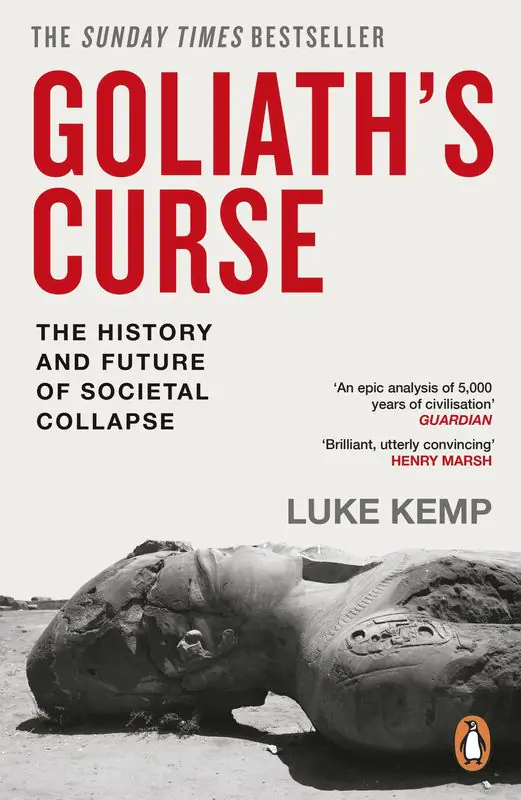
Goliath`s Curse
Masz tę lub inne książki?
Sprzedaj je u nas

A profound reinterpretation of human history highlights the pattern of collapses, stretching from humanity's beginnings to the pressing existential challenges of today and the future. Featured prominently in the BBC series "Civilisations: Rise and Fall" and recognized as a Sunday Times bestseller, this narrative presents a compelling examination of societal development and potential endpoints. As Henry Marsh asserts, the account provides a persuasive exploration into why we might be nearing the final days of humanity. Lewis Dartnell emphasizes the importance of this narrative for comprehending past societal collapses and safeguarding our civilization against a similar downfall.For the majority of human history, beginning about 300,000 years ago, our ancestors lived as hunter-gatherers in adaptable and equitable societies, avoiding any enduring dominance by individuals or groups. This balance shifted approximately 12,000 years ago when people gathered into the first agricultural and urban settlements. The reliance on new resources such as grain and fish, coupled with the invention of powerful weaponry, allowed small groups to seize control of these resources. This turn of events led to a disparity in power distribution, paving the way for hierarchical social structures. Authority was centralized around figures like kings, pharaohs, and emperors, with ideologies emerging to validate their dominion. Consequently, great states and empires with extensive bureaucratic and military powers divided and controlled vast territories.The downfall of these colossal structures was often precipitated by rising inequality and concentrated power. Whether considering early North American cities like Cahokia or South American urban centers like Tiwanaku, or the grand empires of Egypt, Rome, and China, these factors weakened them internally until external disruptions led to their collapse. Rather than being catastrophic, these collapses often turned out to be beneficial for the majority of people.Today, humanity exists under a global Goliath. Dominated by growth-driven, resource-extractive systems such as the fossil fuel industry, big tech, and military-industrial complexes, these institutions collectively pose new threats ranging from climate change to the specter of nuclear conflict. As our systems grow increasingly fast, complex, and interlinked, any forthcoming collapse is expected to be global, rapid, and potentially irreversible. We are faced with a choice: to manage this global Goliath democratically, lest the next collapse be our final one.Reflecting on humanity's history through the rise and fall of imposing empires, as addressed by the Observer and echoed by Peter Turchin, this analysis spans thousands of years from the Paleolithic era to the present, offering vital insights. It serves as a stark yet inspiring historical narrative, as Johann Hari notes, on how societal collapses occur and how we might prevent our own. The narrative reads like an analysis of economics through a dystopian lens, reminiscent of Thomas Piketty's ideas meeting the world of Mad Max, as the New York Times puts it.
Wybierz stan zużycia:
WIĘCEJ O SKALI
A profound reinterpretation of human history highlights the pattern of collapses, stretching from humanity's beginnings to the pressing existential challenges of today and the future. Featured prominently in the BBC series "Civilisations: Rise and Fall" and recognized as a Sunday Times bestseller, this narrative presents a compelling examination of societal development and potential endpoints. As Henry Marsh asserts, the account provides a persuasive exploration into why we might be nearing the final days of humanity. Lewis Dartnell emphasizes the importance of this narrative for comprehending past societal collapses and safeguarding our civilization against a similar downfall.For the majority of human history, beginning about 300,000 years ago, our ancestors lived as hunter-gatherers in adaptable and equitable societies, avoiding any enduring dominance by individuals or groups. This balance shifted approximately 12,000 years ago when people gathered into the first agricultural and urban settlements. The reliance on new resources such as grain and fish, coupled with the invention of powerful weaponry, allowed small groups to seize control of these resources. This turn of events led to a disparity in power distribution, paving the way for hierarchical social structures. Authority was centralized around figures like kings, pharaohs, and emperors, with ideologies emerging to validate their dominion. Consequently, great states and empires with extensive bureaucratic and military powers divided and controlled vast territories.The downfall of these colossal structures was often precipitated by rising inequality and concentrated power. Whether considering early North American cities like Cahokia or South American urban centers like Tiwanaku, or the grand empires of Egypt, Rome, and China, these factors weakened them internally until external disruptions led to their collapse. Rather than being catastrophic, these collapses often turned out to be beneficial for the majority of people.Today, humanity exists under a global Goliath. Dominated by growth-driven, resource-extractive systems such as the fossil fuel industry, big tech, and military-industrial complexes, these institutions collectively pose new threats ranging from climate change to the specter of nuclear conflict. As our systems grow increasingly fast, complex, and interlinked, any forthcoming collapse is expected to be global, rapid, and potentially irreversible. We are faced with a choice: to manage this global Goliath democratically, lest the next collapse be our final one.Reflecting on humanity's history through the rise and fall of imposing empires, as addressed by the Observer and echoed by Peter Turchin, this analysis spans thousands of years from the Paleolithic era to the present, offering vital insights. It serves as a stark yet inspiring historical narrative, as Johann Hari notes, on how societal collapses occur and how we might prevent our own. The narrative reads like an analysis of economics through a dystopian lens, reminiscent of Thomas Piketty's ideas meeting the world of Mad Max, as the New York Times puts it.
Szczegóły
Inne książki: Luke Kemp

Podobne produkty
Może Ci się spodobać
Inne książki z tej samej kategorii

Napisz opinię o książce i wygraj nagrodę!
W każdym miesiącu wybieramy najlepsze opinie i nagradzamy recenzentów.
Dowiedz się więcejWartość nagród w tym miesiącu
880 zł
Dodaj swoją opinię
Zaloguj się na swoje konto, aby mieć możliwość dodawania opinii.
Czy chcesz zostawić tylko ocenę?
Dodanie samej oceny o książce nie jest brane pod uwagę podczas losowania nagród. By mieć szansę na otrzymanie nagrody musisz napisać opinię o książce.
Już oceniłeś/zrecenzowałeś te książkę w przeszłości.
Możliwe jest dodanie tylko jednej recenzji do każdej z książek.
Sposoby dostawy
Odbiór w punkcie (6)
InPost Paczkomat 24/7

13,99 zł
ORLEN Paczka

12,99 zł




Dostawa na adres (7)
GLS U Ciebie - Kurier

14,99 zł
Kurier DPD

14,99 zł





Sposoby płatności
Płatność z góry
Przedpłata

Zwykły przelew
