Stan książek
Nasze książki są dokładnie sprawdzone i jasno określamy stan każdej z nich.

Nowa
Książka nowa.
Używany - jak nowa
Niezauważalne lub prawie niezauważalne ślady używania. Książkę ciężko odróżnić od nowej pozycji.
Używany - dobry
Normalne ślady używania wynikające z kartkowania podczas czytania, brak większych uszkodzeń lub zagięć.
Używany - widoczne ślady użytkowania
zagięte rogi, przyniszczona okładka, książka posiada wszystkie strony.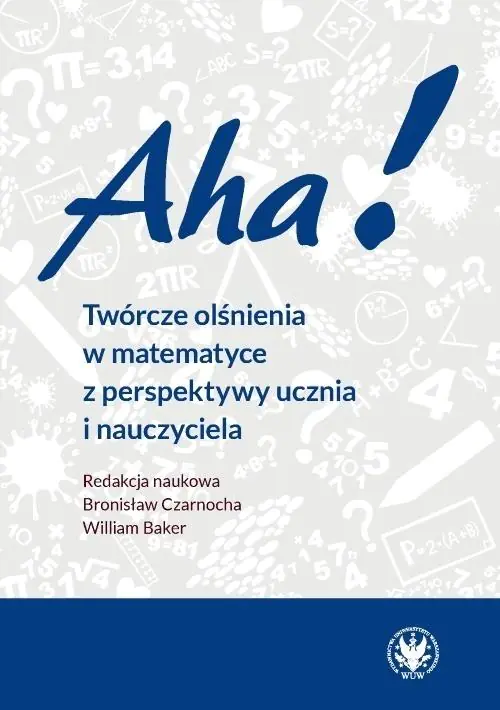
Aha! Twórcze olśnienia w matematyce z perspektywy ucznia i nauczyciela
Masz tę lub inne książki?
Sprzedaj je u nas

The authors of the publication explore the relationship between mathematics and creativity, addressing whether learning math can indeed be a creative process. They assert that math lessons offer a prime opportunity for fostering and investigating creativity, with those spontaneous moments of insight, or "aha!" moments, enhancing the learning process and cognitive growth for all students, not just the exceptionally gifted. The book introduces Koestler's theory of bisociation, which focuses on the creativity found in those aha! moments, into mathematical education. By integrating this theory with constructivist learning concepts, the authors lay the groundwork for a new theory that blends creativity with learning, offering a framework to describe insightful moments throughout various stages of student development. The essays within this publication illuminate the eureka experiences in mathematics, examining them through diverse lenses including emotional impact, cognitive processes, attention theory, neuroscience, and computational creativity.
Wybierz stan zużycia:
WIĘCEJ O SKALI
The authors of the publication explore the relationship between mathematics and creativity, addressing whether learning math can indeed be a creative process. They assert that math lessons offer a prime opportunity for fostering and investigating creativity, with those spontaneous moments of insight, or "aha!" moments, enhancing the learning process and cognitive growth for all students, not just the exceptionally gifted. The book introduces Koestler's theory of bisociation, which focuses on the creativity found in those aha! moments, into mathematical education. By integrating this theory with constructivist learning concepts, the authors lay the groundwork for a new theory that blends creativity with learning, offering a framework to describe insightful moments throughout various stages of student development. The essays within this publication illuminate the eureka experiences in mathematics, examining them through diverse lenses including emotional impact, cognitive processes, attention theory, neuroscience, and computational creativity.
Szczegóły
Inne książki tych autorów

Podobne produkty
Może Ci się spodobać
Inne książki z tej samej kategorii

Napisz opinię o książce i wygraj nagrodę!
W każdym miesiącu wybieramy najlepsze opinie i nagradzamy recenzentów.
Dowiedz się więcejWartość nagród w tym miesiącu
880 zł
Dodaj swoją opinię
Zaloguj się na swoje konto, aby mieć możliwość dodawania opinii.
Czy chcesz zostawić tylko ocenę?
Dodanie samej oceny o książce nie jest brane pod uwagę podczas losowania nagród. By mieć szansę na otrzymanie nagrody musisz napisać opinię o książce.
Już oceniłeś/zrecenzowałeś te książkę w przeszłości.
Możliwe jest dodanie tylko jednej recenzji do każdej z książek.
Sposoby dostawy
Odbiór w punkcie (7)
InPost Paczkomat 24/7

14,99 zł
DPD Pickup Automaty i Punkty Odbioru

10,49 zł





Dostawa na adres (7)
GLS U Ciebie - Kurier

14,99 zł
Kurier DPD

14,99 zł





Sposoby płatności
Płatność z góry
Przedpłata

Zwykły przelew
