Stan książek
Nasze książki są dokładnie sprawdzone i jasno określamy stan każdej z nich.

Nowa
Książka nowa.
Używany - jak nowa
Niezauważalne lub prawie niezauważalne ślady używania. Książkę ciężko odróżnić od nowej pozycji.
Używany - dobry
Normalne ślady używania wynikające z kartkowania podczas czytania, brak większych uszkodzeń lub zagięć.
Używany - widoczne ślady użytkowania
zagięte rogi, przyniszczona okładka, książka posiada wszystkie strony.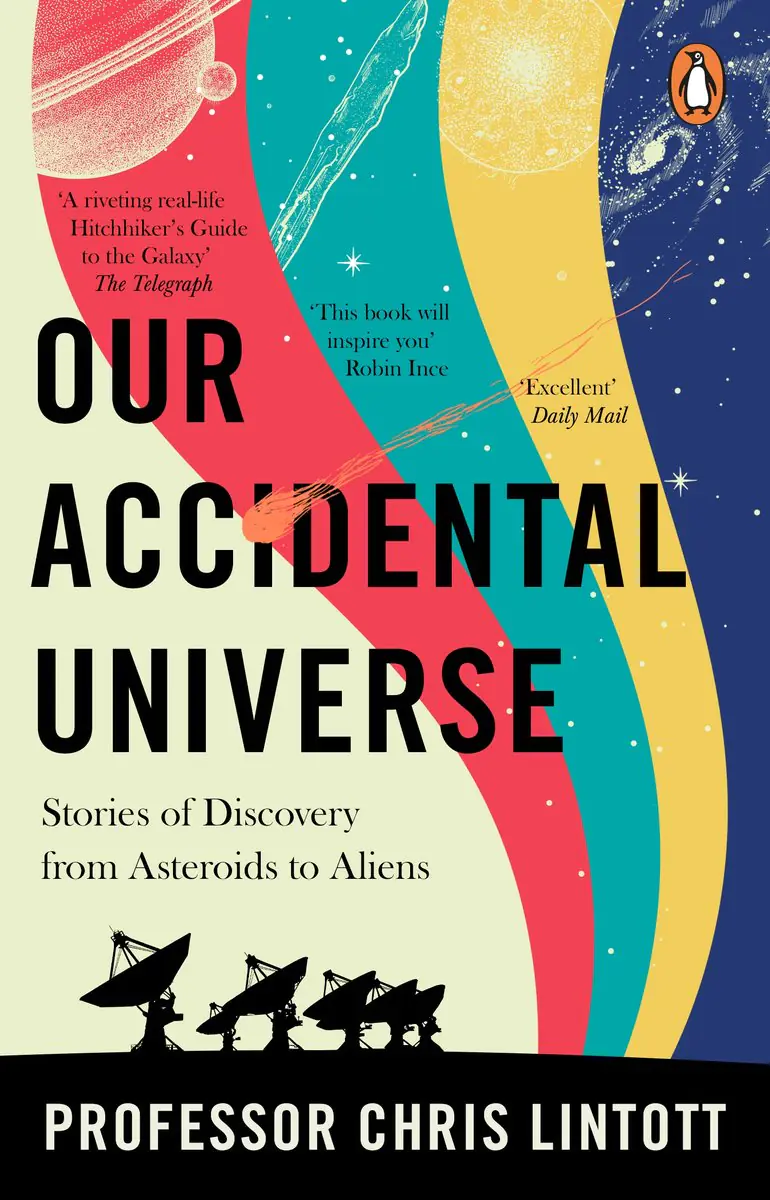
Our Accidental Universe
Masz tę lub inne książki?
Sprzedaj je u nas

Our understanding of the Universe is undergoing a transformation. The once eternal and unchanging firmament above is now recognized as a dynamic entity, leading to the emergence of a new form of astronomy. Across the globe, on mountaintops and in deserts, new telescopes are being constructed to observe this ever-evolving sky. Despite these technological advancements, many significant astronomical discoveries of the last century happened by chance, uncovered unexpectedly while researchers pursued different objectives.Saturn's small moon Enceladus, for instance, emerged as a leading contender for extraterrestrial life. This discovery was made when NASA's Cassini probe fortuitously passed by, revealing the moon's subsurface oceans. Similarly, pulsars were detected not as targeted findings but as anomalies in the data of astronomers examining distant galaxies. When an asteroid from another star system unexpectedly appeared, telescopes worldwide quickly mobilized to study this interstellar visitor. The Hubble Space Telescope, too, provides its most profound insights when directed towards seemingly empty spaces.Chris Lintott's book offers a compelling exploration of serendipitous discoveries and human mistakes in the search for asteroids, pulsars, radio waves, new stars, and potential alien life. With new surveys and instruments about to broaden our cosmic perspective, Lintott makes a compelling case for the value of an open-minded approach to discovery.Chris Lintott's work has been met with high praise. Professor Brian Cox highlights the superb quality of his insights, while Brian May acknowledges Lintott's quiet yet transformative influence on modern astronomy. Michael West from Nature appreciates how Lintott skillfully combines personal experiences with deeper philosophical reflections.
Wybierz stan zużycia:
WIĘCEJ O SKALI
Our understanding of the Universe is undergoing a transformation. The once eternal and unchanging firmament above is now recognized as a dynamic entity, leading to the emergence of a new form of astronomy. Across the globe, on mountaintops and in deserts, new telescopes are being constructed to observe this ever-evolving sky. Despite these technological advancements, many significant astronomical discoveries of the last century happened by chance, uncovered unexpectedly while researchers pursued different objectives.Saturn's small moon Enceladus, for instance, emerged as a leading contender for extraterrestrial life. This discovery was made when NASA's Cassini probe fortuitously passed by, revealing the moon's subsurface oceans. Similarly, pulsars were detected not as targeted findings but as anomalies in the data of astronomers examining distant galaxies. When an asteroid from another star system unexpectedly appeared, telescopes worldwide quickly mobilized to study this interstellar visitor. The Hubble Space Telescope, too, provides its most profound insights when directed towards seemingly empty spaces.Chris Lintott's book offers a compelling exploration of serendipitous discoveries and human mistakes in the search for asteroids, pulsars, radio waves, new stars, and potential alien life. With new surveys and instruments about to broaden our cosmic perspective, Lintott makes a compelling case for the value of an open-minded approach to discovery.Chris Lintott's work has been met with high praise. Professor Brian Cox highlights the superb quality of his insights, while Brian May acknowledges Lintott's quiet yet transformative influence on modern astronomy. Michael West from Nature appreciates how Lintott skillfully combines personal experiences with deeper philosophical reflections.
Szczegóły
Inne książki: Chris Lintott

Podobne produkty
Może Ci się spodobać
Inne książki z tej samej kategorii

Napisz opinię o książce i wygraj nagrodę!
W każdym miesiącu wybieramy najlepsze opinie i nagradzamy recenzentów.
Dowiedz się więcejWartość nagród w tym miesiącu
880 zł
Dodaj swoją opinię
Zaloguj się na swoje konto, aby mieć możliwość dodawania opinii.
Czy chcesz zostawić tylko ocenę?
Dodanie samej oceny o książce nie jest brane pod uwagę podczas losowania nagród. By mieć szansę na otrzymanie nagrody musisz napisać opinię o książce.
Już oceniłeś/zrecenzowałeś te książkę w przeszłości.
Możliwe jest dodanie tylko jednej recenzji do każdej z książek.
Sposoby dostawy
Odbiór w punkcie (7)
InPost Paczkomat 24/7

14,99 zł
DPD Pickup Automaty i Punkty Odbioru

11,99 zł





Dostawa na adres (7)
GLS U Ciebie - Kurier

14,99 zł
Kurier DPD

14,99 zł





Sposoby płatności
Płatność z góry
Przedpłata

Zwykły przelew
