Stan książek
Nasze książki są dokładnie sprawdzone i jasno określamy stan każdej z nich.


Nowa
Książka nowa.
Używany - jak nowa
Niezauważalne lub prawie niezauważalne ślady używania. Książkę ciężko odróżnić od nowej pozycji.
Używany - dobry
Normalne ślady używania wynikające z kartkowania podczas czytania, brak większych uszkodzeń lub zagięć.
Używany - widoczne ślady użytkowania
zagięte rogi, przyniszczona okładka, książka posiada wszystkie strony.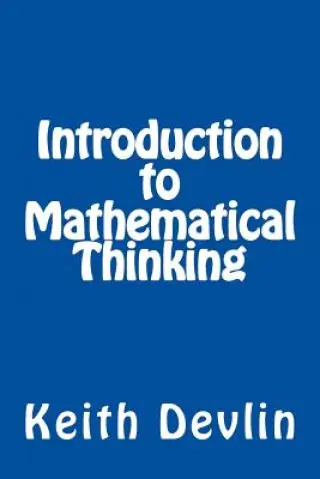
Introduction to Mathematical Thinking
Masz tę lub inne książki?
Sprzedaj je u nas

Mathematical thinking is an invaluable skill in today's world, going beyond mere arithmetic. It involves approaching problems with logic, analysis, and precision, offering a versatile toolset for understanding diverse scenarios. Unlike traditional mathematics, which often sticks to formulas and calculations, mathematical thinking is a broader, more strategic way of approaching issues analytically. Although not an inherent thinking style, it can be learned with time and effort. Traditionally, fields such as mathematics, science, and engineering demand math proficiency, which requires extensive formal education. However, the ability to think mathematically can be acquired in a relatively short time, roughly six weeks, for those with a high school math background. Although the concept doesn't exclusively revolve around math, mathematical principles serve as a perfect playground for developing such thought processes. This forms the basis of Keith Devlin's concise yet impactful book, designed to aid first and second-year STEM students at universities, as well as high schoolers planning to enter STEM fields in higher education. The book addresses the common struggle students face when moving from high school to university mathematics, where the focus shifts drastically towards abstract thinking.To ease this academic transition, many institutions offer a "transition course," for which this book could ideally serve as a main or supplementary text. Moreover, its engaging, concise nature makes it accessible to anyone eager to enhance their analytical skills. By mastering mathematical thinking, STEM students can transform college-level math from something perplexing into an attainable challenge. Authored by Dr. Keith Devlin, a renowned mathematician from Stanford University, this book draws on his extensive experience and numerous accolades, including the Pythagoras Prize and the Carl Sagan Award. Dr. Devlin, recognized by many from NPR's "Weekend Edition" as "the Math Guy," shares his insights through various blogs and books, contributing to a more profound understanding of mathematics in everyday life.
Wybierz stan zużycia:
WIĘCEJ O SKALI
Mathematical thinking is an invaluable skill in today's world, going beyond mere arithmetic. It involves approaching problems with logic, analysis, and precision, offering a versatile toolset for understanding diverse scenarios. Unlike traditional mathematics, which often sticks to formulas and calculations, mathematical thinking is a broader, more strategic way of approaching issues analytically. Although not an inherent thinking style, it can be learned with time and effort. Traditionally, fields such as mathematics, science, and engineering demand math proficiency, which requires extensive formal education. However, the ability to think mathematically can be acquired in a relatively short time, roughly six weeks, for those with a high school math background. Although the concept doesn't exclusively revolve around math, mathematical principles serve as a perfect playground for developing such thought processes. This forms the basis of Keith Devlin's concise yet impactful book, designed to aid first and second-year STEM students at universities, as well as high schoolers planning to enter STEM fields in higher education. The book addresses the common struggle students face when moving from high school to university mathematics, where the focus shifts drastically towards abstract thinking.To ease this academic transition, many institutions offer a "transition course," for which this book could ideally serve as a main or supplementary text. Moreover, its engaging, concise nature makes it accessible to anyone eager to enhance their analytical skills. By mastering mathematical thinking, STEM students can transform college-level math from something perplexing into an attainable challenge. Authored by Dr. Keith Devlin, a renowned mathematician from Stanford University, this book draws on his extensive experience and numerous accolades, including the Pythagoras Prize and the Carl Sagan Award. Dr. Devlin, recognized by many from NPR's "Weekend Edition" as "the Math Guy," shares his insights through various blogs and books, contributing to a more profound understanding of mathematics in everyday life.
Inne książki: Keith Devlin

Podobne produkty
Może Ci się spodobać
Inne książki z tej samej kategorii

Napisz opinię o książce i wygraj nagrodę!
W każdym miesiącu wybieramy najlepsze opinie i nagradzamy recenzentów.
Dowiedz się więcejWartość nagród w tym miesiącu
880 zł
Dodaj swoją opinię
Zaloguj się na swoje konto, aby mieć możliwość dodawania opinii.
Czy chcesz zostawić tylko ocenę?
Dodanie samej oceny o książce nie jest brane pod uwagę podczas losowania nagród. By mieć szansę na otrzymanie nagrody musisz napisać opinię o książce.
Już oceniłeś/zrecenzowałeś te książkę w przeszłości.
Możliwe jest dodanie tylko jednej recenzji do każdej z książek.
Sposoby dostawy
Odbiór w punkcie (7)
InPost Paczkomat 24/7

14,99 zł
DPD Pickup Automaty i Punkty Odbioru

11,99 zł





Dostawa na adres (7)
GLS U Ciebie - Kurier

14,99 zł
Kurier DPD

14,99 zł





Sposoby płatności
Płatność z góry
Przedpłata

Zwykły przelew
